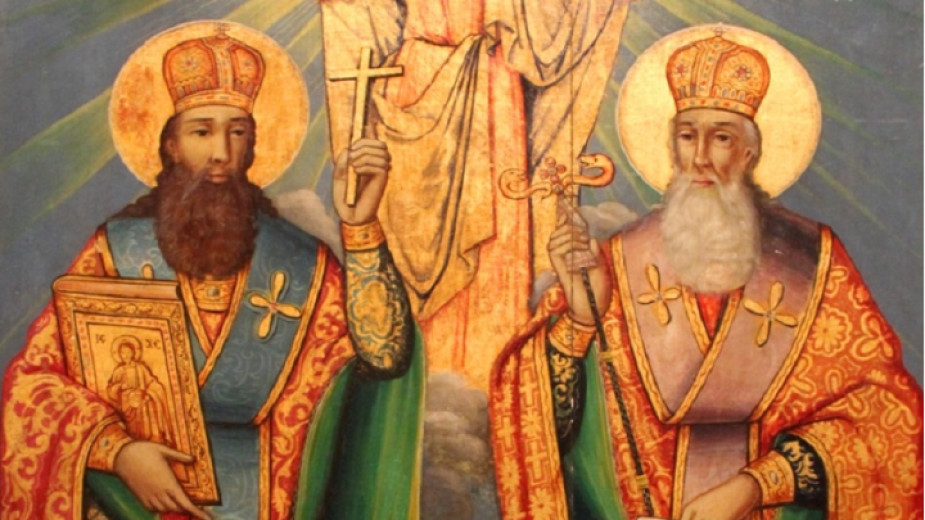
The Camino de Santiago pilgrimage goes back to the Middle Ages. It is, in fact, the first walking trail in Europe. In our day it is part of a total of 48 cultural routes, certified by the Council of Europe, connected with European values and democracy. One of these routes follows the trail of how the work of the men who created the Slavic alphabet, saints Cyril and Methodius was disseminated, and it is the result of many years of work by Bulgarian researchers.
The researchers have identified a huge number of monuments and locations in Europe that are connected with Cyril and Methodius. Alongside Benedict of Nursia, Cyril and Methodius are co-patrons of Europe. “These are the two cultural and spiritual traditions of the continent: The Western tradition of Benedict, and the Eastern tradition – of Cyril and Methodius. However, they shouldn’t be regarded as separate because the work of Cyril and Methodius has spread in the East as well as in the West,” Prof. Slavia Barlieva, director of the Bulgarian Academy of Sciences’ Cyril and Methodius Research Centre explains. “Starting from Germany, where in Reichenau or in Ellwangen, Methodius spent years in exile, going on to Vienna, where throughout the 18th century, celebrations were organized every year honouring the saints Cyril and Methodius at the palace church of imperial Vienna. During the 14th century in Czechia, the work of Saints Cyril and Methodius was used by emperor Charles IV of Luxembourg to boost the self-awareness of the Slavic population. The Glagolitic alphabet was introduced, and though on a modest scale, the feast began to be celebrated by special decree.
In Hungary we find evidence that Cyril and Methodius spent time with Prince Pribina of Blatna principality. In Serbia, and more specifically in Sirmium, or what is today Sremska Mitrovica, Methodius was archbishop. Not to mention Cyril and Methodius’ work in Bulgaria where we find the oldest Bulgarian writings – the epigraphic Glagolitic inscriptions in Pliska. Or the oldest Cyrillic inscription in Krepcha, dated to the year 921. Or the monasteries in Ravda, in Ivanovo, all the churches bearing their names throughout Bulgaria…”
Together with representatives of various institutions and professional organizations, the researchers are now working on the development of a specific tourist product, as part of the European cultural routes initiative. But their work is not just about tourism:
“The scientific part of these efforts is very important, but alongside it there is the educational aspect – young people get involved in the research work,” Prof. Slavia Barlieva says further. “Even school children who started researching how the feast of Cyril and Methodius was celebrated in a given town or village through the eyes of their parents and grandparents. Celebration is a very important phenomenon, as is the fact that there are dozens of churches and temples in Bulgaria that are named after the saints Cyril and Methodius. Because this tradition is a powerful instrument of self-identification.”

The eighth International Violin Competition “Vasco Abadjiev” will take place in Sofia from 20 to 23 November, attracting record interest. The organizers from the UNESCO Club “Leonardo da Vinci” – Sofia are delighted to have received 32 applications..
Stefan Komandarev’s film “Made in EU” has won the Critics’ Prize at the Arras Film Festival in France, the film’s team announced. The jury was composed of film critics and journalists from France 2, France Inter, Allociné, Konbini, Vanity Fair, and..
The first Sound and Light multimedia show took place at Tsarevets fortress in Veliko Tarnovo in 1985. The occasion – the 800 th anniversary of the uprising by Peter and Asen that led to the restoration of Bulgarian statehood after two..




 Mostly Cloudy
 Partly Cloudy
 Cloudy
 Fog
Fog