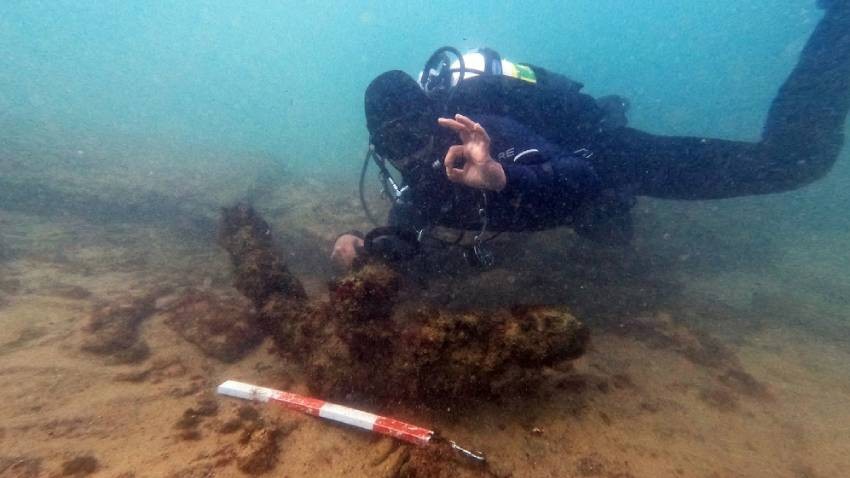
Bulgarian underwater archaeologists led by the Deputy Director of the National History Museum Professor Ivan Hristov found a lead ingot, which reached the waters of the Black Sea from the Roman mines in the Cornwall area. The ingot was found during underwater searches in September and November 2023 north of the mouth of the Kamchia River. The object is dated to the 2nd-4th century. Cornwall and Devon dominated the European tin market from the late Roman times, beginning around the 3rd century AD, as many Spanish tin mines were exhausted.
This is the first find in Bulgarian territorial waters of such a nature and dating. It weighs 5,35 kg and contains 98% pure tin. Ingot from the Black Sea was prepared for delivery to some workshops on land for making bronze objects or coins. Another important find is the location of the remains of a sunken ship from the Ottoman period. A perfectly preserved wooden keel lies on the seabed. The divers also recovered two cannons and fragments of pottery. The ship probably sank in bad weather. It is believed to have crashed on shallow jutting reefs that are hard to see in a storm.

On Friday, the lowest temperatures will be between 4°C and 9°C, reaching up to 12°C in the southeast, around 6°C in Sofia . During the next 24 hours, the weather will remain cloudy. It will rain in almost the entire country. During the day, rainfall..

The Varna District Court has released the city’s mayor, Blagomir Kotsev, on a financial bond of €102,258. Before the court’s decision was announced, supporters of the mayor and members of the We Continue the Change party gathered outside the..

Three people, including an Italian citizen, were arrested during last night's protest against the adoption of the 2026 budget in front of the National Assembly, the director of the Sofia Directorate of Internal Affairs, Chief Commissioner Lyubomir..







 Overcast, rain
 Rain / Snow
 Cloudy
 Scattered showers
 Cloudy
 Rain
Rain